History
Greenwich Park is one of London’s oldest and most historically significant green spaces, with a history that spans more than 600 years. Originally part of a royal hunting ground, the park has been closely connected to the English monarchy since the Middle Ages.
In the 15th century, the land became associated with the Palace of Placentia, a royal residence built by Humphrey, Duke of Gloucester. The palace later became the birthplace of several Tudor monarchs, including Henry VIII and Elizabeth I, cementing Greenwich’s importance in English royal history.
During the 17th century, Greenwich Park was redesigned in a more formal style under the reign of Charles II, influenced by the great gardens of France. Tree-lined avenues and symmetrical layouts were introduced, shaping much of the park’s current structure.
One of the most significant additions to the park was the construction of the Royal Observatory in 1675. Established to improve navigation and maritime knowledge, the Observatory later became world-famous as the home of the Prime Meridian, the reference point for Greenwich Mean Time (GMT).
In the following centuries, Greenwich Park evolved from a royal space into a public one. It was gradually opened to the public and became a place for leisure, science and education. The park played an important role during major historical events, including royal celebrations and national commemorations.
Today, Greenwich Park is part of the Greenwich Maritime World Heritage Site. It combines natural beauty, royal heritage and scientific significance, offering visitors a unique perspective on Britain’s history and its influence on global navigation and timekeeping.
Visit
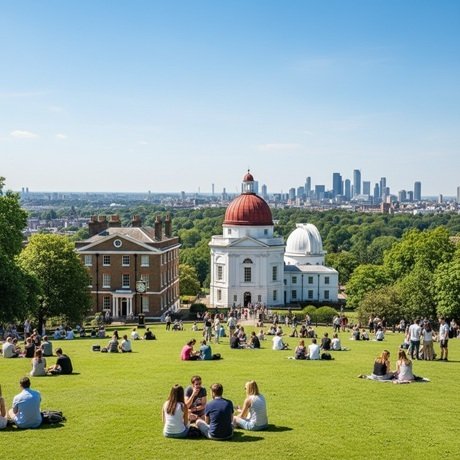
Visiting Greenwich Park offers a peaceful escape from the city while providing spectacular views over the River Thames and the London skyline. The park is ideal for walking, picnics and relaxing among wide open lawns, ancient trees and formal gardens.
A highlight of the visit is the Royal Observatory, where visitors can stand on the Prime Meridian and explore exhibitions dedicated to astronomy and navigation. Nearby attractions include the National Maritime Museum and the Queen’s House.
A typical visit lasts between 1.5 and 3 hours, depending on whether the Observatory and museums are included. The park is beautiful year-round, with spring and summer being particularly popular.
How to get there
Greenwich Park is located in southeast London, in the historic district of Greenwich.
The nearest railway and DLR stations are Greenwich and Cutty Sark (DLR), both within walking distance of the park entrances.
Several bus routes serve the area. An alternative and scenic option is to arrive by Thames river boat, stopping at Greenwich Pier and walking uphill to the park.