History
The London Eye, also known as the Millennium Wheel, is one of the most recognisable modern landmarks in London and a symbol of the city’s transformation at the turn of the 21st century. The idea for the structure was conceived in the early 1990s by architects David Marks and Julia Barfield, who proposed it as a temporary installation to celebrate the new millennium.
Although the project initially faced funding difficulties and bureaucratic delays, construction eventually began in 1998. The wheel was built by assembling its sections horizontally along the River Thames before being slowly lifted into a vertical position — an engineering feat that attracted international attention.
Officially opened to the public in March 2000, the London Eye quickly became one of the most visited attractions in the United Kingdom. Originally intended to remain standing for just five years, its popularity ensured its permanence as part of London’s skyline.
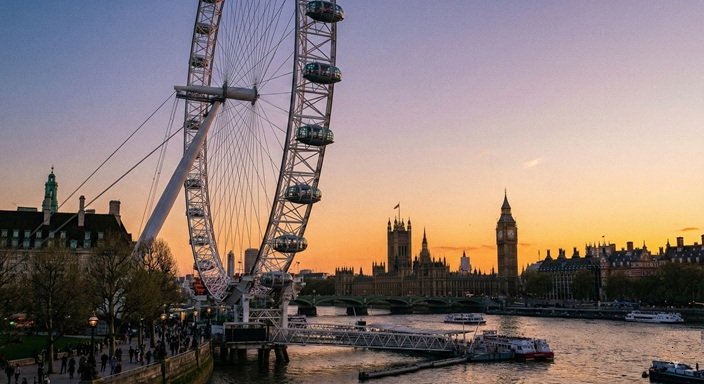
Standing at 135 metres tall, the London Eye was the tallest observation wheel in the world at the time of its completion. Its design features 32 sealed glass capsules, each representing one of London’s boroughs. The slow rotation allows uninterrupted panoramic views across the city, stretching up to 40 kilometres on clear days.
Over the years, the London Eye has changed ownership several times and undergone technical upgrades, including improvements to lighting and capsule technology. It has also become a focal point for major public events, most notably London’s annual New Year’s Eve fireworks, which are launched from the wheel and broadcast worldwide.
Today, the London Eye stands as a modern counterpart to the city’s historic monuments, representing innovation, contemporary architecture, and London’s role as a global capital.
Visit
A visit to the London Eye offers one of the best panoramic views of the city. Each rotation lasts approximately 30 minutes, allowing plenty of time to admire landmarks such as Big Ben, St Paul’s Cathedral, Buckingham Palace, and the River Thames.
The experience takes place inside climate-controlled glass capsules, ensuring comfort in all weather conditions. Special experiences, including private capsules and fast-track tickets, are also available.
Tickets can be purchased online, and advance booking is strongly recommended, especially during weekends, holidays, and peak tourist seasons.
How to get there
The London Eye is located on the South Bank of the River Thames, directly opposite the Houses of Parliament.
The nearest Underground stations are Waterloo (Bakerloo, Jubilee, Northern, Waterloo & City), Westminster (District, Circle, Jubilee), and Embankment (District, Circle, Bakerloo, Northern).
Numerous bus routes serve the South Bank area, and London Waterloo railway station is just a few minutes’ walk from the attraction.