History
Tower Bridge is one of London’s most famous and recognisable landmarks, combining Victorian engineering with striking neo-Gothic architecture. Its construction was the result of London’s rapid expansion during the second half of the 19th century, when increased traffic and commercial activity in the East End created an urgent need for a new river crossing.
In the late 19th century, the existing bridges were no longer sufficient to support the growing flow of people, vehicles, and goods across the River Thames. However, any new bridge had to allow tall ships to continue accessing the Port of London, one of the busiest ports in the world at the time. After years of debate and design proposals, a special committee approved a unique solution: a bridge with a central section capable of opening to let ships pass.
Construction began in 1886 and lasted eight years. The project was designed by Sir Horace Jones, the City Architect, and later completed by engineer Sir John Wolfe Barry. The bridge officially opened on 30 June 1894, in the presence of the Prince of Wales (later King Edward VII).
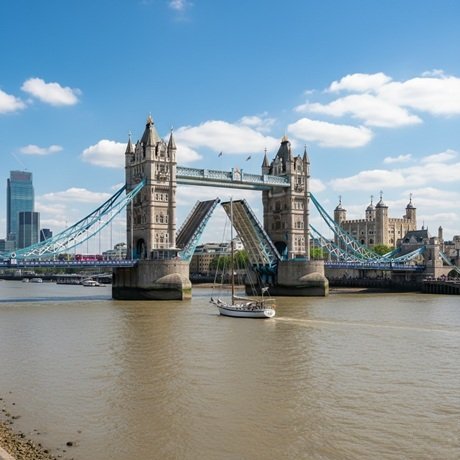
Tower Bridge consists of two massive towers connected at the upper level by high-level walkways and at the lower level by two bascules (movable roadways). These bascules could be raised in just a few minutes using a sophisticated hydraulic system powered by steam engines, allowing even the largest vessels to pass through. At the time, this mechanism represented one of the most advanced feats of engineering in the world.
Although its appearance suggests a medieval structure, the bridge’s neo-Gothic style was deliberately chosen to harmonise with the nearby Tower of London. Beneath its stone façade lies a steel framework weighing over 11,000 tons, which provides the bridge with its strength and durability.
The high-level walkways, originally intended for pedestrians when the bascules were raised, soon fell out of use due to their steep staircases and association with crime. They were closed in 1910 but later reopened in 1982 as part of the Tower Bridge Exhibition, offering panoramic views over London.
Throughout the 20th century, Tower Bridge underwent several upgrades and restorations. In 1976, the original steam-powered hydraulic system was replaced with an electro-hydraulic mechanism, while maintaining the bridge’s historic appearance. A major refurbishment between 2008 and 2012 restored the bridge’s iconic colours and improved visitor facilities.
Today, Tower Bridge remains a vital road crossing and a powerful symbol of London, representing the city’s ability to combine tradition, innovation, and architectural beauty. It stands as a lasting reminder of Victorian ambition and engineering excellence.
Visit
Visiting Tower Bridge offers a unique opportunity to explore both a working bridge and a historic monument. The Tower Bridge Exhibition includes access to the high-level walkways, which feature a spectacular glass floor offering views of the Thames and the traffic below.
The visit also includes the historic engine rooms, where original steam engines are displayed and the bridge’s lifting mechanism is explained.
A complete visit usually takes around 1–1.5 hours. Tickets can be purchased online, and advance booking is recommended, especially during weekends and peak tourist seasons.
How to get there
Tower Bridge is located in central London, near the Tower of London, spanning the River Thames.
The nearest Underground stations are Tower Hill (District and Circle lines) and London Bridge (Jubilee and Northern lines), both within a 10-minute walk.
Several bus routes stop close to the bridge, and London Bridge Station provides easy access for visitors arriving by train.