History
The origins of Buckingham Palace date back to the early 18th century. In 1698, the land—once a marshy area on the edge of the royal gardens—was purchased by John Sheffield, the future 1st Duke of Buckingham. In 1703, the duke commissioned a new residence known as Buckingham House, designed by architect William Winde and completed around 1705.
In 1761, the property was bought by King George III as a private residence for his wife, Queen Charlotte. From 1762 onward, architect Sir William Chambers renovated and enlarged the building, transforming it into an elegant and refined home with richly decorated interiors and some of the most prestigious reception rooms of the period.
When George IV came to the throne in 1820, he decided to convert Buckingham House into a true royal palace. He appointed architect John Nash to oversee a major transformation: Nash redesigned the building into a grand U-shaped palace, enlarging the central block and both wings, and creating a large internal courtyard. He also constructed a triumphal arch at the main entrance to commemorate Britain’s military victories. The cost of the works, however, grew dramatically and exceeded £450,000—an enormous sum for the time.
In 1837, with the accession of Queen Victoria, Buckingham Palace became the official residence of the British monarch. Under her reign, the palace continued to expand. Architect Edward Blore added new state rooms and reorganized the layout of the interiors. The Marble Arch—originally built as the palace’s main entrance—was dismantled and moved to the northeast corner of Hyde Park.
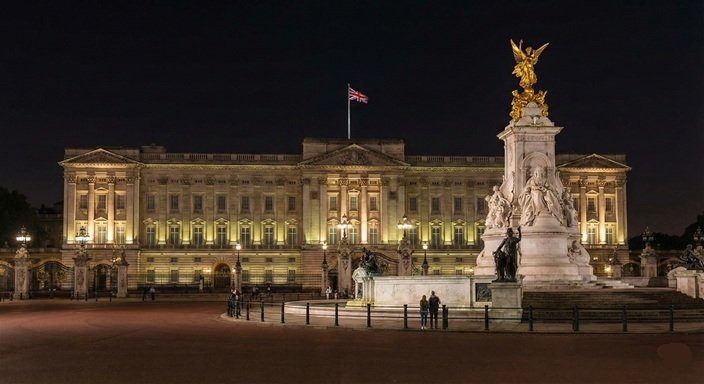
At the end of the 19th century and beginning of the 20th, the palace underwent further modifications, including the construction of the famous East Front, the façade that today overlooks The Mall and forms the iconic backdrop for royal celebrations. This façade was later redecorated in 1913 to give it the more sober and monumental appearance seen today.
During World War II, Buckingham Palace was bombed several times and suffered significant damage. Despite this, the royal family remained in London, and the palace continued to serve as a symbol of national resistance and unity. In 1962, on the site of the chapel destroyed by bombing, the Queen’s Gallery was opened, providing a public exhibition space for masterpieces from the Royal Collection.
Today, Buckingham Palace covers around 77,000 square meters and includes over 700 rooms, among which are state rooms, private royal apartments, offices, and staff quarters. The palace remains the administrative and ceremonial heart of the British monarchy and one of the most recognizable landmarks in the United Kingdom.
Visit
The State Rooms of Buckingham Palace are usually open to the public during the summer months.
The visit includes the ceremonial halls, historic furnishings and, in some ticket options, access to the gardens; the average duration is 2–3 hours.
Booking in advance is recommended, especially in summer and on weekends, when visitor numbers are higher.
How to get there
Buckingham Palace is located between Green Park and St James's Park, postcode SW1A 1AA.
The nearest underground stations are Victoria (Victoria, District, Circle lines), Green Park (Piccadilly, Victoria, Jubilee lines) and St James's Park (District and Circle lines); all are about a 5–10 minute walk from the palace.
Several bus routes stop nearby, and if you arrive by train, Victoria Station is the closest major rail hub.