History
The origins of Westminster Abbey date back to the 10th century, when King Edward the Confessor ordered the construction of a Benedictine monastery on Thorney Island, then a marshy area near the River Thames. The abbey was consecrated in 1065, just a few days before the king’s death, and quickly became an important religious and political centre in Norman England.
The building’s current appearance is the result of a major reconstruction begun in 1245 under the reign of Henry III, who intended to transform Westminster into a masterpiece of Gothic architecture and make it his own burial place. The abbey thus assumed an imposing French Gothic style, with high ribbed vaults, pointed arches and large stained-glass windows.
In the following centuries, Westminster Abbey strengthened its role as the central ceremonial site of the British monarchy. Since 1066, with the coronation of William the Conqueror, the abbey has been the location of almost every royal coronation, a tradition that continues to this day.
In addition to coronations, Westminster Abbey houses the tombs of over 1,000 notable figures, including monarchs, statesmen, scientists and writers. The famous Poets’ Corner contains the tombs or memorials of Shakespeare, Dickens, Chaucer, Kipling and many other central figures of English culture.
The 14th and 15th centuries saw further expansions, including the construction of the Lady Chapel commissioned by Henry VII, considered one of the finest examples of English Perpendicular Gothic. In the 18th century, the two western towers were added, designed by Nicholas Hawksmoor, giving the abbey its iconic skyline.
Despite the turbulent events of the Reformation and the centuries that followed, Westminster Abbey has remained a symbol of national continuity. Today it serves simultaneously as a place of worship, a historic site, a venue for official ceremonies and one of the United Kingdom’s most important cultural attractions.
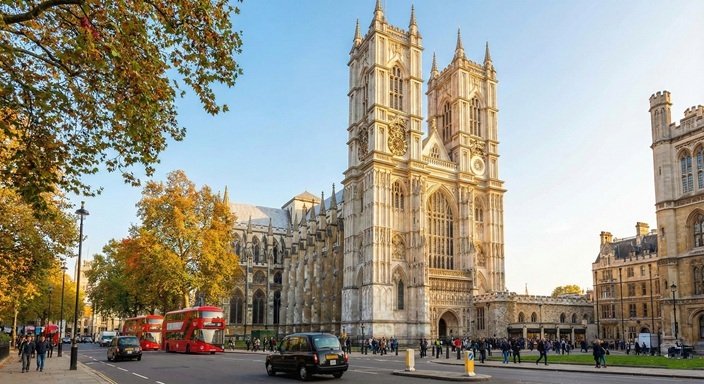
Visit
Westminster Abbey is open to visitors and offers one of London’s most fascinating sightseeing experiences, with royal tombs, Gothic chapels, cloisters and historic monuments.
A complete visit takes around 1.5–2 hours and includes entry to the Lady Chapel, the Poets’ Corner, the Coronation Chair and the medieval cloisters.
Tickets can be purchased online, and advance booking is highly recommended, especially on weekends and during spring and summer. Audio guides are available in Italian.
How to Get There
Westminster Abbey is located in Westminster, just a short walk from Parliament and Big Ben.
The nearest underground stations are Westminster (District, Circle, Jubilee) and St James’s Park (District, Circle), both about a 5-minute walk away.
Numerous bus lines stop along Victoria Street and Parliament Square; for those arriving by train, the closest major station is London Victoria, about 15 minutes on foot.